Was the policy in force, and had the relevant waiting period ended? If the date evidence is missing, stop the payment estimate.

Feline policy decisions
Cat insurance plans: follow the claim branches
Use a feline scenario to distinguish eligibility, selected benefits and the eventual payment.
Policy-first
Independent
Useful checks
Key checks
What matters on this page
Use these checkpoints to frame the literal question before reading the full guide.
History before math
Apply the specimen’s timing and history tests
A later diagnosis cannot erase earlier signs
Benefits selected?
Separate exam, take-home and routine charges
Options do not override an excluded event
$700 or $820
Exam selection changes the worked payment
Hypothetical eligible visit; premiums extra
Direct answer
For cat insurance plans, first ask whether the event is eligible, then whether each expense is included, and only then calculate payment. The same visit can contain eligible treatment and costs that remain yours.
The sections below show how to verify the answer and what can change it.
Branch one: what brought the cat to the vet?
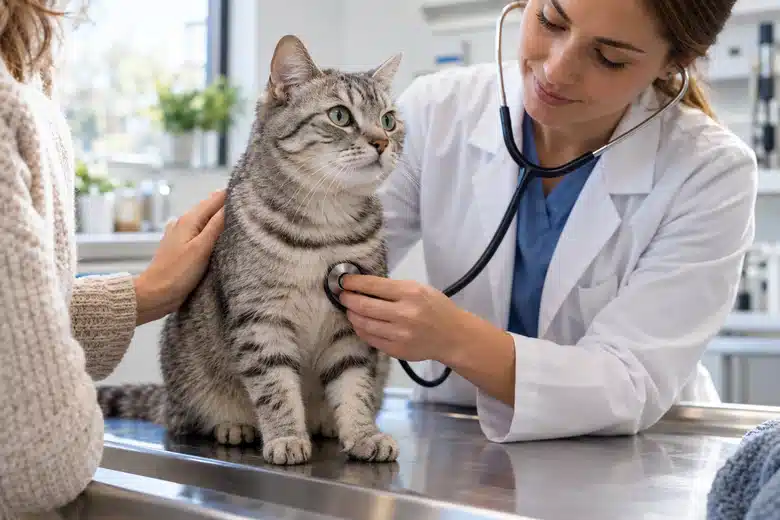
Consider a hypothetical cat brought to a clinic after a newly noticed illness. This is an insurance reading exercise, not medical advice or a diagnosis. Do not delay veterinary care while deciding whether a claim may qualify. Keep the onset history accurate and ask the vet to document the reason for the visit and individual services. All following dates and selections are hypothetical: policy effective January 1, 2026; first illness signs February 1 and treatment February 2; no earlier consistent signs, advice or treatment. Assume no other exclusion applies. This is not a real cat’s history or an issued schedule.
Process
Use stop conditions before numbers
Do the records and applicable exclusions support eligibility? If the condition is excluded, do not apply reimbursement arithmetic to its treatment.
Which invoice lines are within selected benefits? Set aside unsupported items rather than treating the whole visit as eligible.
What deductible, insurer share and remaining limit apply? Only after the first three checks should a calculation begin.
A scoped contract example for a cat
The California specimen linked by Pets Best, IAIC-PBI0001-ILL (02/2023), defines its pet as a domestic cat or dog (10.P). Section 9 addresses pre-existing conditions and preventive care; section 2.B and the California amendment’s replacement table make supplemental selections important. This is a specific specimen example, not a universal feline coverage rule or a confirmation of today’s issued contract.
Evidence matrix
Map the hypothetical visit
| Decision | Controlling evidence | Result before payment |
|---|---|---|
| New illness treatment | History, dates and exclusions | Eligibility must be established |
| Examination charge | Selected supplemental benefits | Do not assume it follows the treatment automatically |
| Take-home item | Selected benefit and applicable formulary | An item needs its own support |
| Routine service at the same visit | Preventive-care terms or separate benefit | Keep it separate from illness treatment |
| Claim amount | Definitions and remaining schedule values | Calculate only supported expenses |
New illness treatment
Controlling evidence
History, dates and exclusions
Result before payment
Eligibility must be established
Examination charge
Controlling evidence
Selected supplemental benefits
Result before payment
Do not assume it follows the treatment automatically
Take-home item
Controlling evidence
Selected benefit and applicable formulary
Result before payment
An item needs its own support
Routine service at the same visit
Controlling evidence
Preventive-care terms or separate benefit
Result before payment
Keep it separate from illness treatment
Claim amount
Controlling evidence
Definitions and remaining schedule values
Result before payment
Calculate only supported expenses
Compare with the details in front of you
Find Coverage for Your Pet
Ready to check current rates?
Keep policy terms, deductible, reimbursement and limits beside the quote so the comparison stays consistent.
Now run a deliberately bounded payment example
Evidence matrix
Apply the specimen to each hypothetical branch
| Branch | Clause and hypothetical input | Result before payment |
|---|---|---|
| Illness timing | CA specimen 2.C; hypothetical January 1 effective date, February 1 onset | The 14-day illness wait has elapsed. A January 8 onset instead fails even if diagnosis occurs in February; no reimbursement calculation for that event. No waiver is assumed. |
| Prior history | 9.A and 10.S; no earlier consistent signs, treatment or advice assumed | The base branch passes this history test. A consistent condition present in the preceding 18 months instead stops payment; chronic, bilateral and disc conditions have the stated any-prior-time exceptions, not a blanket 18-month reset. |
| $1,000 illness treatment | Otherwise eligible clinic treatment; section 1 | Carry $1,000 into payment arithmetic only in the passing history/timing branch. |
| $150 examination | 2.B.1 and 9.C.1; exam supplement OFF at enrollment | Exclude $150. In the alternate branch, exam supplement ON and exam treating the eligible illness add $150; selection cannot rescue an excluded illness. |
| Take-home medication | 2.B.2 and 9.C.1–2; supplement OFF; no take-home charge in this bill | An additional take-home charge would be excluded. With supplement ON, it must be prescribed for an eligible condition and on the applicable formulary; do not add it to this $1,200 invoice. |
| $50 routine vaccination | 9.B; no separate routine-care benefit assumed | Exclude $50 even in the exam-ON branch. The resulting eligible totals are $1,000 or $1,150 before payment. |
Illness timing
Clause and hypothetical input
CA specimen 2.C; hypothetical January 1 effective date, February 1 onset
Result before payment
The 14-day illness wait has elapsed. A January 8 onset instead fails even if diagnosis occurs in February; no reimbursement calculation for that event. No waiver is assumed.
Prior history
Clause and hypothetical input
9.A and 10.S; no earlier consistent signs, treatment or advice assumed
Result before payment
The base branch passes this history test. A consistent condition present in the preceding 18 months instead stops payment; chronic, bilateral and disc conditions have the stated any-prior-time exceptions, not a blanket 18-month reset.
$1,000 illness treatment
Clause and hypothetical input
Otherwise eligible clinic treatment; section 1
Result before payment
Carry $1,000 into payment arithmetic only in the passing history/timing branch.
$150 examination
Clause and hypothetical input
2.B.1 and 9.C.1; exam supplement OFF at enrollment
Result before payment
Exclude $150. In the alternate branch, exam supplement ON and exam treating the eligible illness add $150; selection cannot rescue an excluded illness.
Take-home medication
Clause and hypothetical input
2.B.2 and 9.C.1–2; supplement OFF; no take-home charge in this bill
Result before payment
An additional take-home charge would be excluded. With supplement ON, it must be prescribed for an eligible condition and on the applicable formulary; do not add it to this $1,200 invoice.
$50 routine vaccination
Clause and hypothetical input
9.B; no separate routine-care benefit assumed
Result before payment
Exclude $50 even in the exam-ON branch. The resulting eligible totals are $1,000 or $1,150 before payment.
Assume, only for illustration, $1,200 total charges: $150 unsupported examination cost and $50 routine expense, leaving $1,000 eligible. Suppose the insurer share is 80%, the remaining deductible $100 and the annual limit has room. Using the specimen’s percentage-before-deductible method gives $700 reimbursement and $500 net invoice cost to the owner, excluding premiums. If the exam benefit is selected and that $150 is also eligible, reimbursement would instead be $820 under the same assumptions. The $120 change comes from the included expense, not a different diagnosis.
This sensitivity exercise shows why a cat owner should audit optional benefits before comparing percentages. It does not say a real cat’s examination, medicine or illness will be covered. The schedule must support the selections, and the records must support eligibility. If the required evidence is absent, the honest answer is unresolved.
Take these documents away from the appointment
Practical checks
A claim-ready record
Itemization
Keep charges separated rather than relying on a single total for treatment plus routine care.
History
Retain earlier veterinary and adoption records, including dates and unresolved findings.
Insurance explanation
Reconcile each insurer adjustment with the invoice and policy; keep the deductible and limit balances for the next visit.
When choosing a plan for a cat, use this path on the expenses you actually want to protect against. Do not import a dog-specific feature or an unverified national benefit claim into the decision. Ask for the full state-specific policy packet and its selected schedule before applying the example to an offer.
Evidence matrix
Feline branches beyond the single-visit calculation
| Hypothetical cat scenario | Verified CA wording | Bounded result |
|---|---|---|
| Maine Coon with a newly suspected inherited heart condition | Section 1 covers eligible conditions subject to exclusions; 9.A and 10.H/S/T control prior/chronic history. The retrieved form does not supply a separate unconditional hereditary guarantee | Breed or an inherited label alone does not prove payment. If first signs follow the wait with no prior consistent condition, continue the clause audit; no verified hereditary-specific yes is asserted. |
| Older cat with renal disease already managed before enrollment | 10.H includes renal disease among chronic examples; 9.A.1 reaches chronic conditions present at any earlier time; 10.T includes controlled/remission conditions | Do not call it newly eligible merely because the latest diagnosis or flare-up is recent or treatment paused for 18 months. |
| Cat with new otherwise eligible illness and an exam | 2.B.1 and 9.C.1 require selected exam supplement; existing illustration separates $150 exam | Exam OFF retains the charge; exam ON still requires an eligible underlying event. Treatment eligibility does not automatically pay every visit fee. |
| Take-home prescription or rehabilitation | 2.B.2–3 and 9.C: selected supplements, formulary where applicable, eligible underlying condition | No take-home payment is assumed from in-clinic treatment alone; routine vaccination remains separate under 9.B. |
Maine Coon with a newly suspected inherited heart condition
Verified CA wording
Section 1 covers eligible conditions subject to exclusions; 9.A and 10.H/S/T control prior/chronic history. The retrieved form does not supply a separate unconditional hereditary guarantee
Bounded result
Breed or an inherited label alone does not prove payment. If first signs follow the wait with no prior consistent condition, continue the clause audit; no verified hereditary-specific yes is asserted.
Older cat with renal disease already managed before enrollment
Verified CA wording
10.H includes renal disease among chronic examples; 9.A.1 reaches chronic conditions present at any earlier time; 10.T includes controlled/remission conditions
Bounded result
Do not call it newly eligible merely because the latest diagnosis or flare-up is recent or treatment paused for 18 months.
Cat with new otherwise eligible illness and an exam
Verified CA wording
2.B.1 and 9.C.1 require selected exam supplement; existing illustration separates $150 exam
Bounded result
Exam OFF retains the charge; exam ON still requires an eligible underlying event. Treatment eligibility does not automatically pay every visit fee.
Take-home prescription or rehabilitation
Verified CA wording
2.B.2–3 and 9.C: selected supplements, formulary where applicable, eligible underlying condition
Bounded result
No take-home payment is assumed from in-clinic treatment alone; routine vaccination remains separate under 9.B.
All four branches use the California specimen and amendment identified above, not every cat plan. This is a feline eligibility-and-option audit: it neither predicts disease from breed nor recommends treatment.
Pet Insurance Lens
See Insurance Rates
Ready to compare with clearer inputs?
Keep the policy terms beside the price, then continue to rates when the comparison is clear.